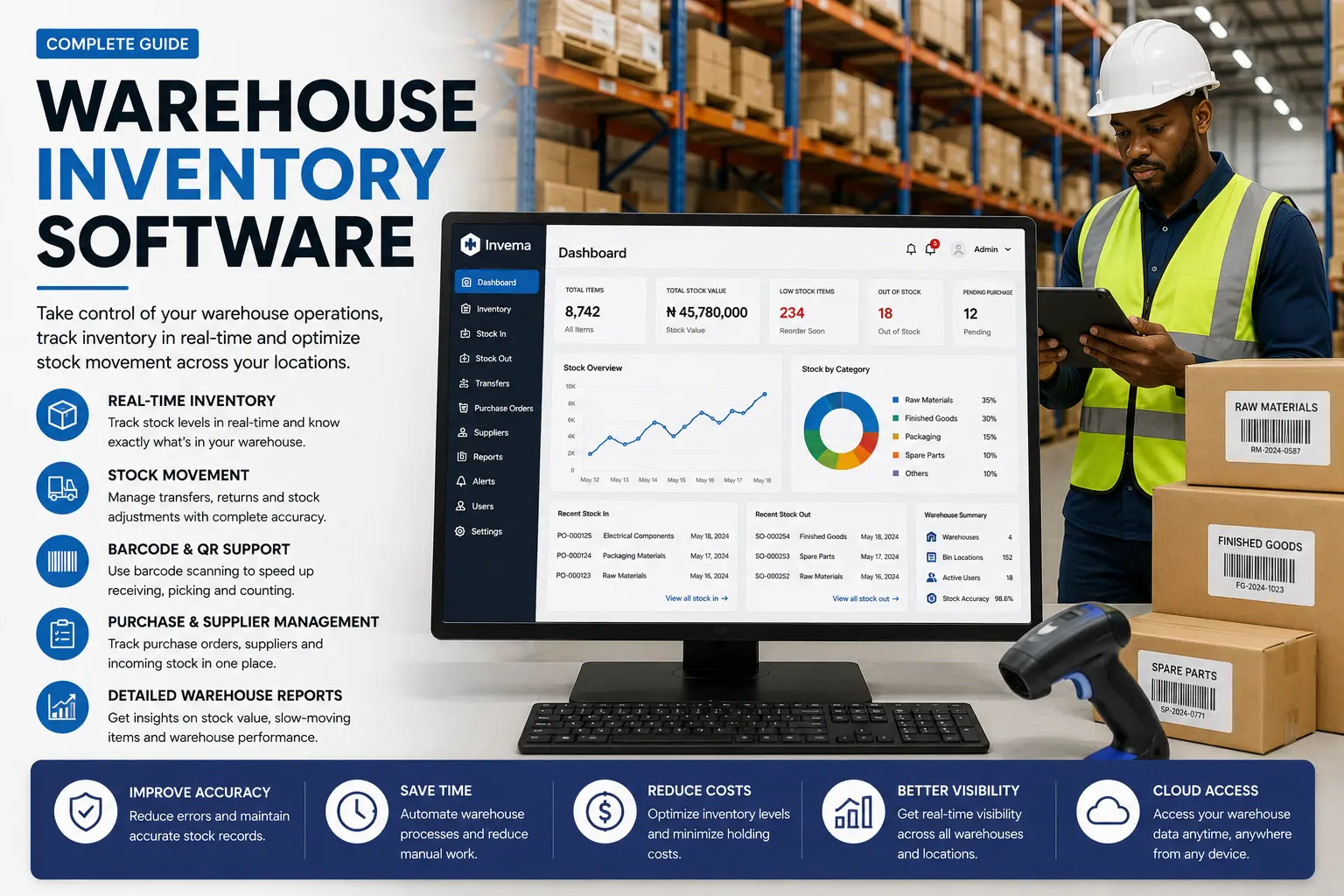
Warehouse control requires more discipline than simple stock counting
Warehouses are built around movement. Products are received, stored, transferred, picked, and dispatched in patterns that can become difficult to track when the business relies on spreadsheets or delayed manual updates. The larger the operation, the more expensive poor visibility becomes. Items are misplaced, purchase timing becomes less reliable, and management loses confidence in how much stock is truly available. That is why warehouse inventory software is so important for distributors, wholesalers, and businesses holding stock at scale in Nigeria.
A warehouse needs a system that supports process discipline without slowing the team down. Staff should know what was received, where it belongs, what has moved, and what still needs attention. Managers should be able to review supplier-linked receipts, track transfer history, and plan replenishment with better evidence. When those records are weak, the warehouse becomes reactive. Teams spend more time searching, correcting, and explaining than actually moving goods efficiently.
What warehouse software should make visible
The most valuable feature is movement clarity. Every receipt, transfer, adjustment, and dispatch should leave a dependable record. That visibility helps the business understand not just stock balances, but the path products took to get there. This becomes especially important when multiple staff touch the same items or when high-volume days create room for mistakes. If the software can show movement clearly, managers can identify process gaps quickly and reduce repeated errors.
Warehouse operations also depend on better purchasing timing. If receiving history and stock levels are reliable, procurement teams can act with more confidence. They can identify which items are turning faster, which suppliers are arriving consistently, and where capital is being tied up unnecessarily. In that sense, warehouse software overlaps strongly with broader stock management software goals, but it places heavier emphasis on movement control and operational traceability.
Why barcode support matters in warehouses
Manual entry becomes especially risky in warehouse environments because the volume of movement is higher and the cost of errors is larger. Barcode workflows help the team confirm receipts faster, reduce typing mistakes, and improve count accuracy. They also make routine processes less dependent on memory. This is why operators comparing warehouse systems often pair their research with guides on barcode inventory software. The speed benefit is useful, but the accuracy benefit is usually even more important.
For businesses running both warehouse and retail operations, connected systems are essential. Stock should move smoothly from warehouse receipt to store availability without requiring duplicate records. When inventory software handles this well, branch replenishment becomes easier and management can respond more confidently to demand shifts. That connection is particularly valuable for growing businesses that also need retail inventory software or multi-branch visibility.
How warehouse software supports better management
Operational control improves when leaders can review the right reports quickly. A warehouse manager should be able to see inbound activity, outbound trends, adjustment patterns, and items approaching reorder points. An owner or director should be able to understand stock value, high-turn products, and areas where process breakdown is causing preventable cost. These reports do not need to be complicated. They need to be current enough and clear enough to support action.
Warehouse software also reduces the burden of investigation. When discrepancies occur, management can review recorded actions instead of starting from assumptions. That makes accountability more practical and less emotional. It also helps teams improve because the discussion becomes about process evidence rather than blame.
Choosing a warehouse solution in Nigeria
The best warehouse inventory software for Nigerian businesses is the one that matches local operating realities. It should support structured receiving, reliable movement tracking, barcode integration, and resilient day-to-day use even when connectivity is inconsistent. It should also remain understandable for staff, because overly complex systems often collapse back into side records and unofficial shortcuts.
Warehouse control is not only about storage. It is about making sure products move through the business with fewer surprises and better planning. When software supports that goal well, the warehouse stops being a blind spot and becomes a source of operational confidence.
Frequently Asked Questions
What is the main benefit of warehouse inventory software?
The main benefit is cleaner visibility into stock movement, which improves receiving, dispatch, purchasing, and accountability.
Do warehouses need barcode tools?
Yes, in most cases. Barcode support improves accuracy and speed across receiving, counts, and dispatch preparation.
Can warehouse software support retail distribution too?
Yes. Connected systems help businesses move stock from warehouse to store more reliably and report on it with less delay.