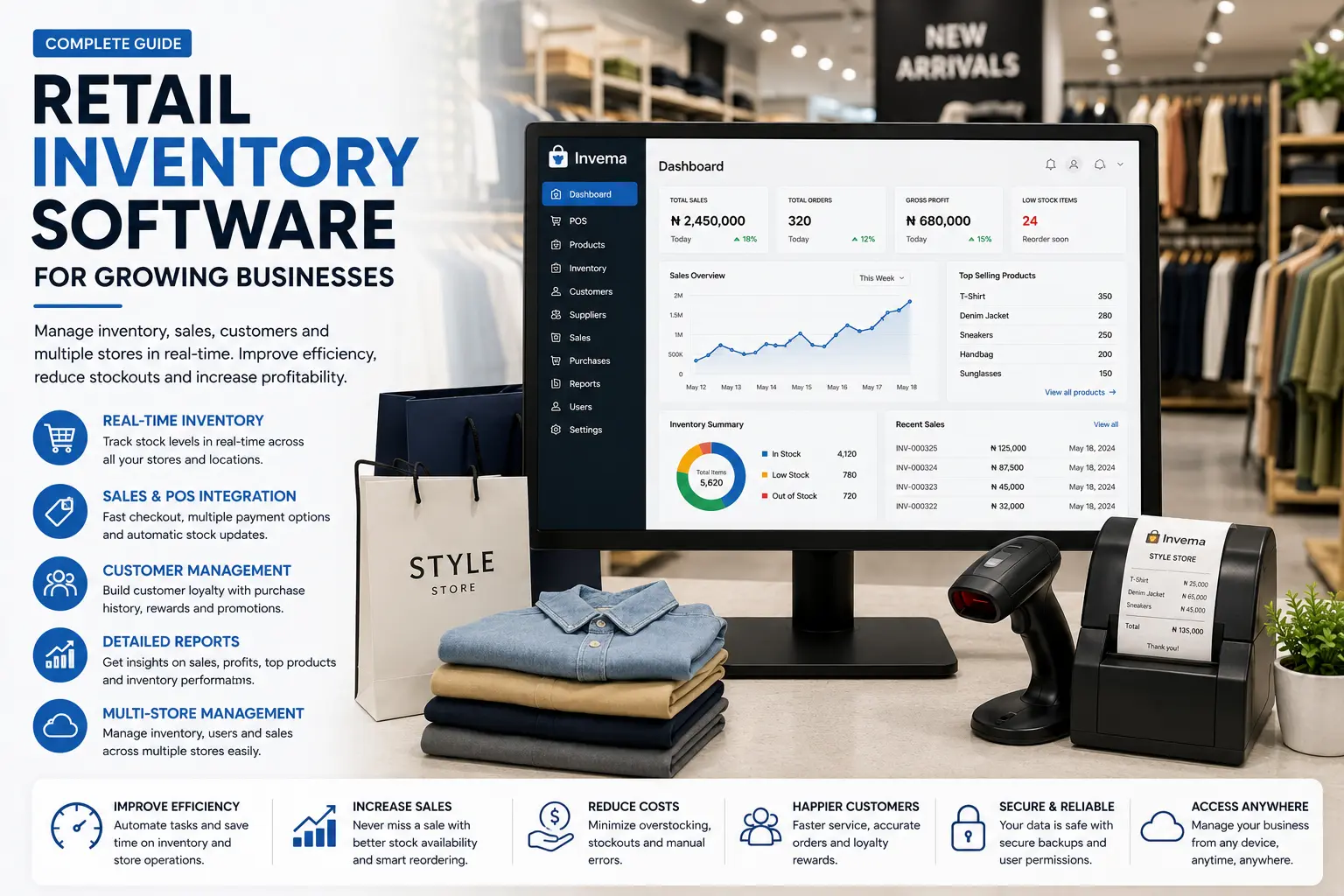
Why retail stock control breaks down without the right system
Retail businesses in Nigeria move quickly. Customers expect products to be available, checkout to be smooth, and pricing to be clear. At the same time, owners are managing supplier pressure, staff coordination, margin protection, and daily reconciliation. When stock records are handled manually, small errors multiply fast. A missing sales entry becomes an unexplained shortage. A delayed stock update becomes a false reorder. A pricing inconsistency becomes lost trust at the counter. That is why retail inventory software plays such an important role in keeping daily operations dependable.
For many shops, the first sign that manual methods are failing is confusion at the point of sale. Staff cannot confirm quantities confidently, popular items run out unexpectedly, and end-of-day counts take too long. As product range grows, the store needs more than a product register. It needs a live operating view of stock movement, sales patterns, and purchase timing. Businesses searching for better retail control often discover that once they fix inventory visibility, several other problems start improving too, including customer service, staff accountability, and buying discipline.
What strong retail software should make easier
The best retail systems reduce friction in the busiest parts of the day. Products should be easy to search, barcode scanning should speed up sales and receiving, and adjustments should be traceable without turning every workflow into paperwork. When teams can work faster with fewer mistakes, store performance improves without adding unnecessary complexity. This is one reason many retailers pair their inventory decision with broader thinking around barcode inventory software and shop management software requirements.
Good software should also improve restocking decisions. Retailers lose money both when best sellers are unavailable and when shelves are filled with slow movers that lock up cash. Clear movement history and trend reports help the owner buy with more confidence. Instead of relying only on supplier suggestions or instinct, the business can see which items truly deserve shelf space. That visibility becomes especially valuable during seasonal demand swings, school periods, holiday spikes, and inflation-driven changes in customer buying habits.
Retail operators need accurate, simple reporting
Retail is full of fast operational questions. Which products sold most this week? Which branch has too much stock? Which cashier handled the largest sales volume? Which category is contributing margin and which one is only taking space? Inventory software becomes useful when it answers those questions clearly. The goal is not to create complicated dashboards that no one uses. The goal is to give managers enough visibility to act faster and with less guesswork.
For stores with multiple counters or multiple branches, this becomes even more important. As soon as operations spread across locations, manual reporting slows down and trust in the numbers falls. A connected platform that feeds into a multi store POS system helps leadership compare performance and identify stock imbalances earlier. It also improves branch coordination because transfers, receiving, and selling activity all sit inside a single operational record.
Why Nigerian retailers should care about resilience
Many software demos look polished under perfect conditions, but retail operations are shaped by real-world constraints. Internet outages, power interruptions, staff turnover, and supplier timing all affect how the store runs. That is why resilience matters so much. Retailers need software that keeps them trading during unstable connectivity and synchronizes when conditions improve. They also need workflows that new staff can learn quickly. A complicated tool creates dependency on one experienced operator, which becomes risky during leave, turnover, or expansion.
The right system should feel practical from the start. It should support product setup, category structure, pricing control, stock counts, and sales workflows without forcing the team into unnecessary admin. Retailers that later expand into supermarket, fashion, electronics, or neighbourhood chain formats should still be able to grow on the same foundation. That is part of why many businesses evaluating retail software also read broader guides on inventory software Nigeria and stock management software.
Retail software should improve customer experience too
Inventory control is often treated as an internal issue, but customers feel its impact directly. When stock information is inaccurate, they face out-of-stock disappointments, delayed service, and inconsistent pricing. When the system works well, staff can answer questions faster, checkout is smoother, and shelves reflect stronger planning. Better internal control creates a better buying experience, which is part of how retail software supports growth even though its primary job is operational.
For Nigerian retailers, software selection should be grounded in daily execution. The best platform is not necessarily the one with the longest feature list. It is the one that helps the team receive stock correctly, sell confidently, replenish wisely, and review performance without delay. When those pieces come together, inventory control becomes a growth advantage rather than a recurring headache.
Frequently Asked Questions
What is the most important benefit of retail inventory software?
The most immediate benefit is cleaner stock visibility. That leads to better replenishment, fewer stockouts, faster checkout, and stronger accountability.
Can retail software work for small and growing shops?
Yes. Small shops benefit from early discipline, while growing stores benefit from reports, barcode workflows, and branch-level visibility as operations expand.
Should retailers link POS and inventory in one system?
Yes. When sales and stock movement live in the same system, reporting becomes more reliable and reconciliation becomes much easier.