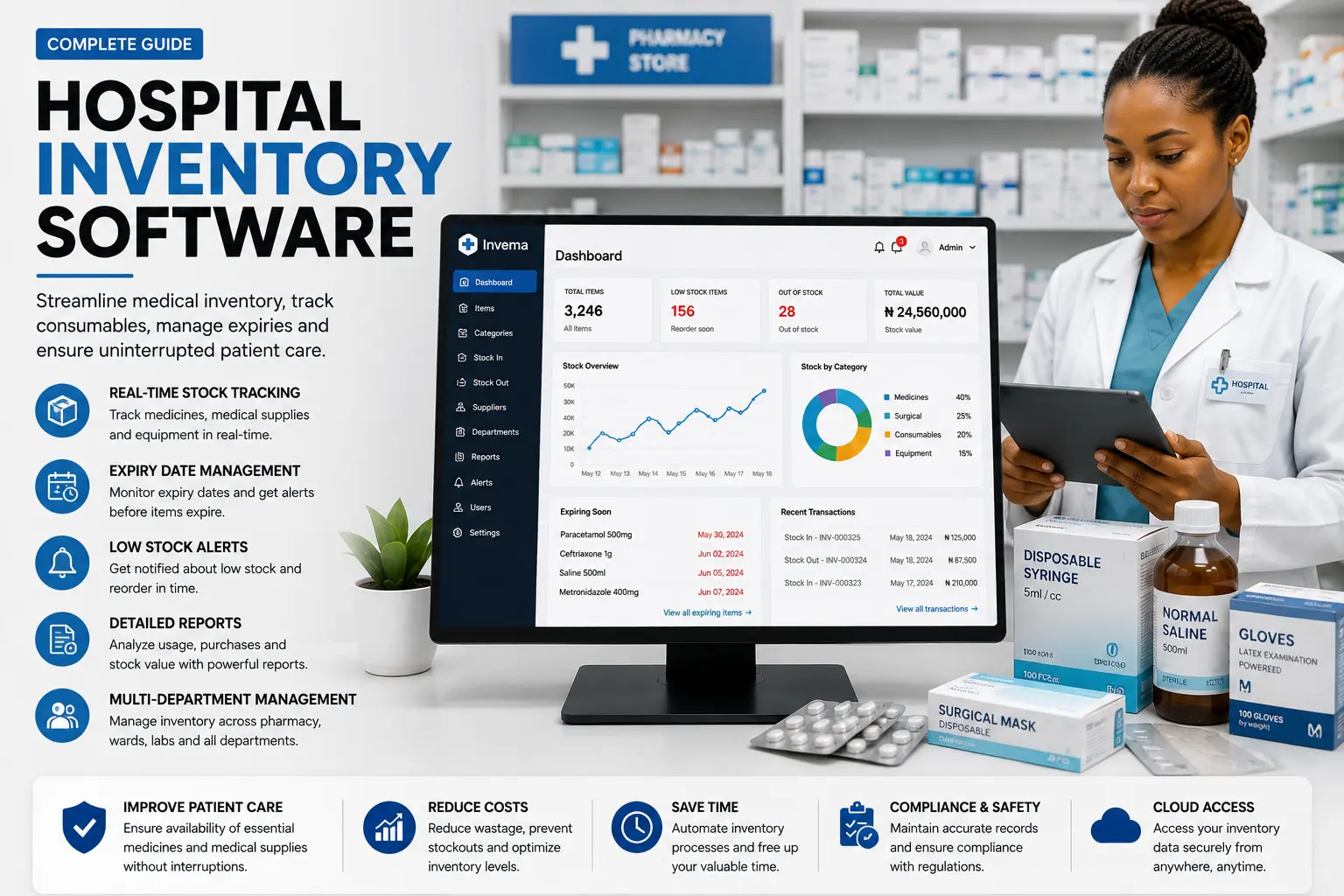
Hospital inventory is an operational and service-delivery issue
Hospitals and clinics depend on reliable access to medicines, consumables, and treatment-support materials. When stock visibility is poor, the cost is not only financial. It can also affect service continuity, internal coordination, and patient confidence. That is why hospital inventory software should be evaluated with more seriousness than ordinary stock tools. The system must support supply discipline while remaining practical for the teams responsible for day-to-day handling.
In many healthcare settings across Nigeria, inventory processes evolve over time through manual forms, stock books, and verbal coordination between departments. Those methods can work at a very small scale, but they become risky once product volume, treatment demand, and team size grow. Management needs clearer oversight of receipts, internal requests, dispensing-linked movement, and products approaching expiry. Without that structure, shortages arrive unexpectedly and too much time is spent chasing answers after the fact.
Where hospital inventory software creates value
The first area is availability control. Hospitals need confidence that essential items are in stock when needed. Better reporting helps management identify fast-moving products, reorder earlier, and reduce avoidable stockouts. The second area is accountability. Every adjustment, receipt, or issue to a department should be visible enough to investigate discrepancies without confusion. The third area is expiry awareness, especially for medicines and sensitive supplies. That overlap is why hospital operators often benefit from reading both pharmacy inventory software and drug expiry management guidance.
Hospitals also need a system that respects internal complexity. Some stock is sold, some is dispensed internally, and some supports service delivery without direct retail movement. Good software should allow management to track those flows without making the process too difficult for staff. The goal is to increase clarity, not add unnecessary administrative burden during already busy operational days.
Why expiry and batch visibility matter
Healthcare inventory cannot rely on total quantity alone. Teams need to know what stock is nearing expiry, which batch was received, and how products should be rotated. That protects margin by reducing avoidable waste and supports better internal discipline. When near-expiry products are only discovered late, the hospital loses money and may face service pressure as replacement stock is sourced urgently.
Batch-aware processes also improve traceability. If questions arise around a product source or timing, management can review the record more confidently. This level of control is especially valuable in larger facilities, busy hospital pharmacies, and integrated clinic groups where supply decisions affect many people and many departments.
Software should support coordination across teams
Hospital inventory control touches procurement staff, storekeepers, pharmacists, finance teams, and clinical operations. If each group works with a different unofficial record, decision quality falls. A shared system helps create one trusted view of stock movement and demand patterns. It does not remove the need for good procedures, but it makes those procedures easier to maintain. That is how software becomes a coordination tool instead of just a reporting tool.
Facilities with several branches or multiple operating units can also benefit from branch-level visibility, especially when leadership wants to compare usage patterns or manage centralized buying. In those cases, ideas from multi store POS systems and broader inventory software Nigeria guidance become relevant because the core challenge is still shared visibility across locations.
Choosing hospital software in practical terms
Healthcare teams should test the software against real workflows: receiving, department requests, stock checks, dispensing-linked updates, expiry review, and report extraction. If the system feels too complicated during those common activities, adoption will be difficult. Usability matters because hospitals need consistent use from several roles, not only from one administrator.
The best hospital inventory software is the one that improves availability, accountability, and expiry control while fitting the pace of real healthcare operations. When implemented well, it reduces uncertainty for managers and supports better service for the people who depend on the facility every day.
Frequently Asked Questions
Why is hospital inventory control different from normal retail stock control?
Hospitals handle internal supply flows, expiry-sensitive products, and service-critical items, so availability and traceability matter more than simple sales tracking alone.
Should hospitals care about batch and expiry visibility?
Yes. Those controls reduce waste, improve traceability, and support safer supply handling.
Can hospital software overlap with pharmacy software?
Yes. There is strong overlap, especially where hospital pharmacies manage medicines, consumables, and dispensing-related stock movement.